

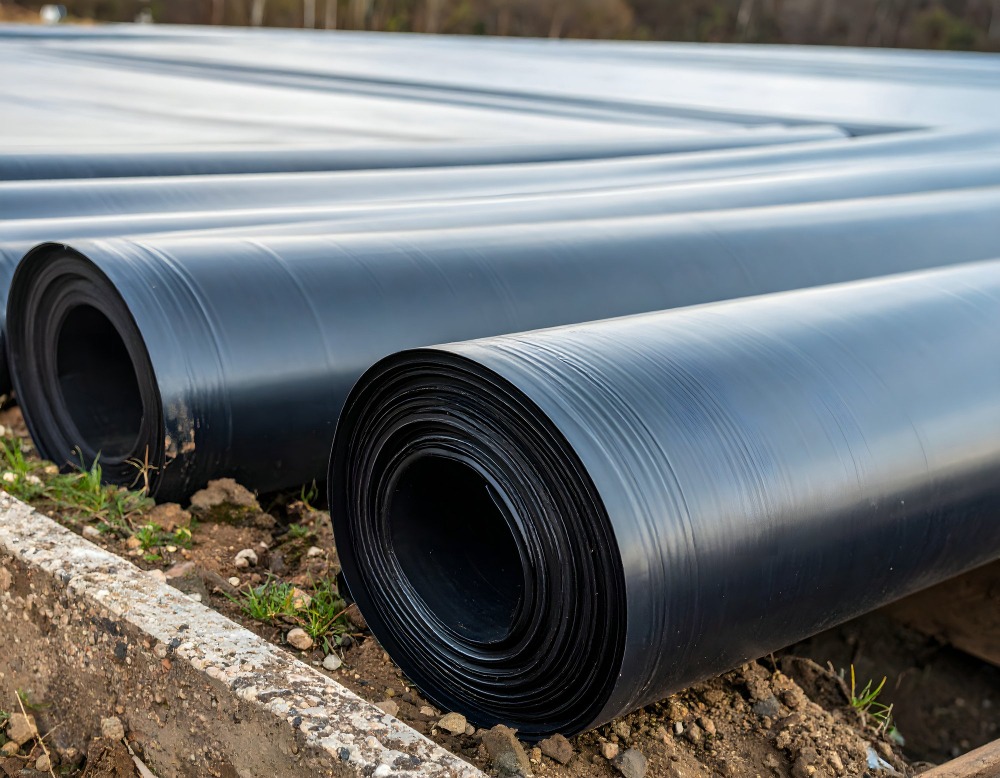
Controlling the movement of liquids through soil or constructed containment areas is an important requirement in many civil, environmental, water-management, and industrial projects. HDPE Geo-Membrane Liner systems provide a low-permeability barrier that can be incorporated into properly designed containment applications.
For projects around Nagpur and other parts of Maharashtra, geomembrane lining may be considered for water storage, waste-management areas, industrial containment, ponds, and other applications where uncontrolled seepage needs to be reduced.
What Is an HDPE Geomembrane?
HDPE stands for high-density polyethylene. In geomembrane applications, sheets manufactured from this material are installed to form a continuous barrier over a prepared surface.
The material itself is only one part of the system.
Successful lining also depends on:
- Subgrade preparation
- Sheet thickness and specification
- Panel layout
- Welding quality
- Joint inspection
- Protection against puncture
- Anchorage
- Drainage design
- Site conditions
A liner should therefore be treated as an engineered installation rather than simply plastic sheeting placed over the ground.
Where Can It Be Used?
HDPE geomembranes have a broad range of potential applications.
Depending on engineering requirements, they may be used for:
- Water storage ponds
- Industrial containment
- Effluent-management areas
- Landfill-related applications
- Agricultural ponds
- Canal or reservoir lining
- Wastewater facilities
- Secondary containment
- Certain mining and processing applications
- Environmental protection projects
The appropriate liner specification depends on what is being contained and the conditions the membrane will experience.
Subgrade Preparation Comes First
A poorly prepared surface can create problems even when good-quality membrane material is used.
Sharp stones, debris, protrusions, uneven areas, and unstable soil can place localized stress on the liner. The installation area should therefore be prepared according to the project design before membrane placement begins.
In some systems, additional protective geotextile layers may be specified to reduce the risk of puncture.
Seams Deserve Particular Attention
Individual sheets must normally be joined to create the required continuous barrier. This makes seam quality one of the most important parts of installation.
Welding should be carried out using appropriate equipment and procedures suitable for the specified membrane. Completed seams may also require testing according to project quality requirements.
Simply inspecting a weld visually may not be sufficient for critical containment applications.
Design for Actual Site Conditions
Projects around Nagpur can encounter high temperatures, seasonal rainfall, variable soil conditions, and different industrial operating environments.
A geomembrane system should therefore be designed around actual exposure rather than selected solely by price per square metre.
Questions worth addressing include:
- What liquid or material will be contained?
- What is the required design life?
- Will the liner remain exposed?
- Is chemical resistance important?
- What mechanical stresses are expected?
- How will the membrane be anchored?
- What protection is needed during operation?
Civitech Services Pvt Ltd works with civil engineering and construction-related solutions in Nagpur where containment and site-specific material selection may form part of the project requirement.
For developers, contractors, infrastructure companies, and industrial facilities, an HDPE geomembrane liner should be evaluated as a complete system. Material quality is important, but surface preparation, welding, detailing, inspection, and protection ultimately determine how effectively the installed liner performs.